
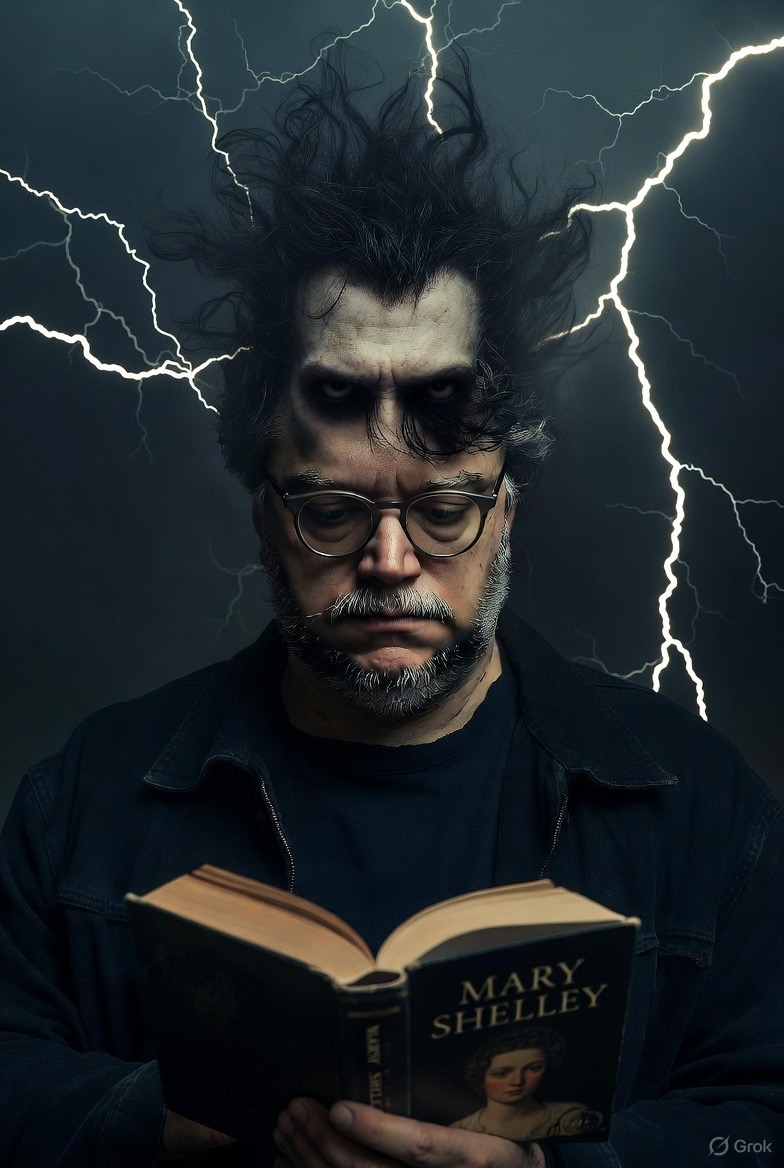
Guillermo del Toro’s Frankenstein is a work of art in the fullest sense of the concept—the «Gesamtkunstwerk» envisioned by Richard Wagner. Every detail is crafted with the eye of a poet, allowing beauty to reveal itself in each frame. The production design is breathtaking. Rarely has the Gothic atmosphere been captured with such artistic precision, making the viewer feel physically present, breathing the same air as the characters.
The music composed by Alexandre Desplat is sublime, while the costumes become a symbolic language in themselves, rich with interpretive clues suggested by the colors, the forms, and the sheen of the jewels—authentic collector’s pieces. The landscapes—the ice of the North Pole with the stranded ship, the sun with its caressing chromatic palette, the forest discovered by virgin eyes that make it appear enchanted, the library reminiscent of the Monastery of San Lorenzo de El Escorial, the palace halls, the dining room, the building where the laboratory rises, the university classroom, and the catacombs where the creature is chained—each scene becomes an image transformed into art and beauty, to the point that if we were to watch the film solely to analyze its aesthetics, we would already be satisfied.
But the point is that these details are only the frame surrounding the best Frankenstein story ever brought to the screen—or ever written—rivaling Mary Shelley’s original itself.
Del Toro understood the essence of the character as if he had stepped inside the heart of its creator and felt the same pulses she experienced while writing those pages on the shores of Lake Lemán. The figure of the “monster” abandons the Hollywood cliché and becomes a Greek sculpture, with scars that do not horrify because they are the traces of a story—like a human kintsugi.
The screenplay is magnificent, the unmistakable work of someone raised in a library, reading each book with the compulsion of the enchanted. Del Toro is not only an extraordinarily gifted filmmaker but also a brilliant writer, demonstrating with each phrase that the same talent he applies to cinema also creates literary universes.
There is one line that has stayed with me since I heard it in the film. After reviewing his life and lying on his deathbed, Victor says to the creature: “I want you to speak my name, which never meant anything to me. I want you to say it as you did when I gave you life, when the sound of it held your entire universe.” It is a thought laden with the accumulated emotions of a lifetime, expressed at its apex—the moment when we realize we have witnessed the story of a father and a son, rendered with a depth rarely achieved by any artist.
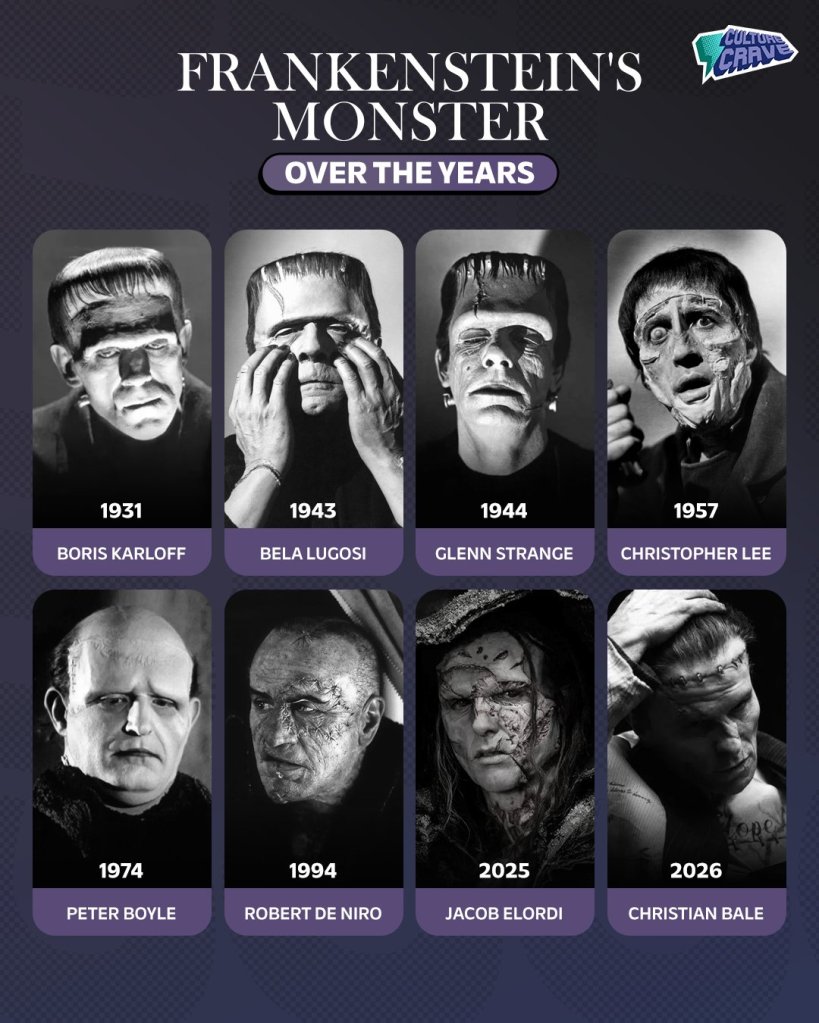
Del Toro captures the essence of Frankenstein, and he made the wise decision to cast a young actor whose destiny changed with this opportunity. Jacob Elordi is young, yet carries within him a world of emotions found in wise old men—men who have lived and suffered, walking the roads of existence while feeling every possible emotion along the way.
Elordi’s performance is one of the finest I have ever seen. It is astonishing to witness such virtuosity from an emerging actor with a full career ahead of him: the ability to convey such complex feelings through a glance, a movement, a shift in posture, a facial expression, or the perfect tonal modulation of his voice. It is a memorable performance, worthy of the most prestigious awards and destined to remain forever in the viewer’s memory.
It is a difficult role; every scene risks slipping into caricature with a single misstep. Yet there are none—not one. Every moment Elordi appears on screen is a master class, something only possible when the actor has felt in his very entrails the emotions he expresses. When he claims he had never identified so precisely with a character, we believe him.
For the first time, we see a Frankenstein who evokes the tenderness and compassion intrinsic to him—the innocence and wonder, the fear and restrained rage, the longing for humanity, and above all, the solitude: the darkest, quietest, coldest solitude.
Elordi is a magician in generating these emotions. He provokes overwhelming empathy—so much so that one wants to step into the screen and embrace him. The other actors, talented and experienced, appear like novices beside this performer who belongs in the same league as Daniel Day-Lewis and Christian Bale.
Guillermo del Toro also succeeds (finally, someone does!) in capturing Shelley’s intention when she called her literary child “The Modern Prometheus.” The Mexican director endows Frankenstein with the immortality of the gods and with the power to save humanity through his actions. The redeeming fire produces rebirth, and includes the immersion in water that evokes the image of a child within the maternal womb. His body regenerates from any attack, and the strength he displays is enough to move a ship and alter the fate of its crew, granting them life and the possibility of sailing toward a promising horizon.
If Prometheus returned fire to humankind, Frankenstein gives human warmth to his creator and hope to the sailors who, like the Pequod crew in Moby-Dick, represent all of humanity. Since ancient Greece, the gods have envied our mortality. In Frankenstein, that longing becomes palpable, and it is no small accomplishment that Del Toro makes us feel the importance of memento mori—and the justified reason for Olympus to envy mortals.
Del Toro’s monster is not merely Victor’s creation. In this film, Frankenstein is what he should be: a wandering spirit yearning for love and understanding, colliding with human nature in all its miseries and limitations.
Guillermo del Toro’s “monster” is a leap forward in human evolution. His Frankenstein is a beautiful being who needs only a noble gesture to feel alive and worthy.







Deja un comentario