
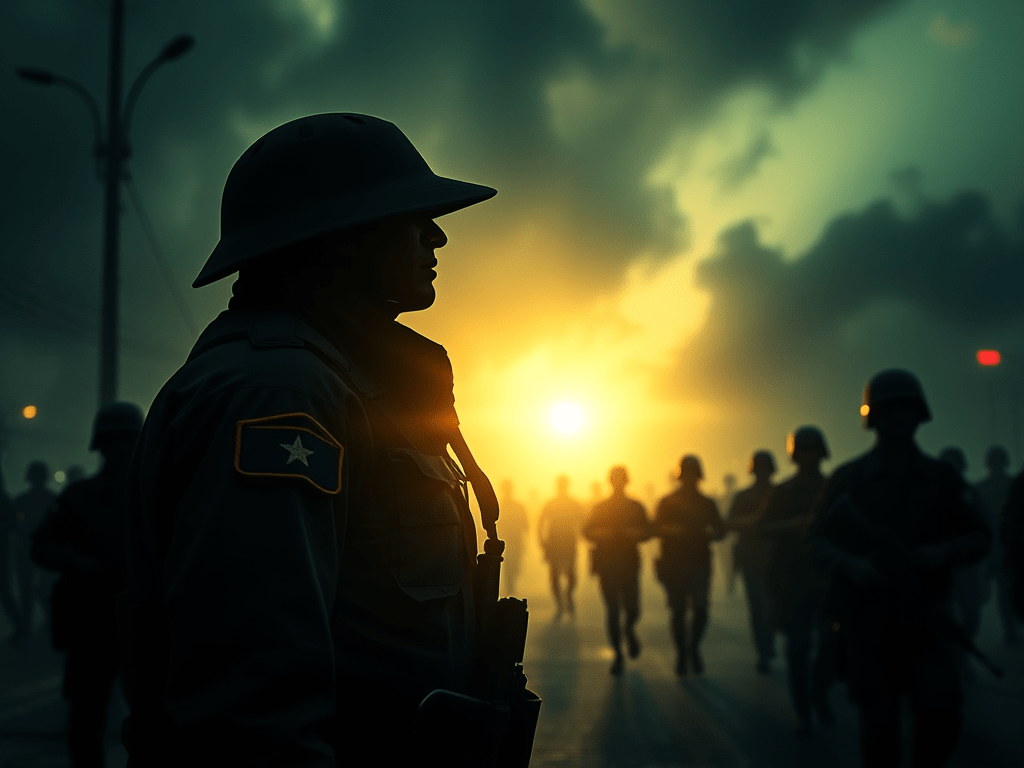
Contemporary Venezuelan history is made of mirages: signs that look like omens, rumors disguised as certainties, and voices announcing imminences that never arrive. Among all these illusions, none has been as persistent, as seductive, or as useless as the idea of a “military breakdown.” It is the modern myth of the country: the endless wait for men in green who will never come.
For years it has been repeated, almost like a secular prayer, that a faction of the Armed Forces might rebel, break the silence, and produce the fissure through which light would finally enter. But that hope rests on an innocent premise: the belief that Venezuela still has conventional armed forces. It does not. What remains is merely the shadow of an institution that was dismantled, hollowed out, and rebuilt on the logic of fear and absolute obedience.
In its place arose another structure, one with no constitutional foundation: militias, colectivos, and irregular groups trained in insurgency tactics and armed with Russian technology. This swarm— invisible to classical Western intelligence frameworks— is today the true armed power of Venezuela. The old FANB retains only the uniform, the parades, the emblems that recall what it once was. Its main function is symbolic: to give the impression of normality to a country that ceased to be normal long ago.
The high command are no longer soldiers; they are survivors, infernal mutants. They amassed power and wealth in the very process by which they destroyed their own fate: those who carry on their shoulders crimes that do not expire know that leaving power is not retirement —it is a death sentence. Their families know it too; they live under a threat that is not metaphorical, because they are the material potential of revenge. In that ecosystem, loyalty is not a virtue —it is self-defense.
Mid-ranking officers wait their turn to join the feast; lower ranks survive as they can, fully aware that no heroic gesture will be recognized, or even possible. Those who tried ended up as indigent exiles in Colombia, without shelter or food, without trade or hope. The chain of command has become fiction: a theater in which military forms are imitated while the internal logic belongs to a completely different order.
And yet, every few years a familiar character reappears— such as the one who read Carmona Estanga’s infamous decree, even though the moment did not belong to him— announcing movements, divisions, imminent changes. He says nothing new, but he does say something useful: he distracts. He feeds the mirage. He contributes to the vast machinery of psychological operations that the regime has perfected and that, at times, the United States also employs when it wants to move pieces on the Caribbean geopolitical board.
Washington commits an error that is more cultural than strategic: it interprets Venezuela as if it were still a country that responds to traditional categories. They speak of military breakdowns, of institutional checks, of pressure and transitions, as though it were a conventional failed state rather than a hybrid structure where crime, intelligence, and coercion intertwine until they become indistinguishable. They do not understand— or do not wish to understand— that the logic governing Venezuela today is that of systematized fear: obedience does not come from discipline, but from survival.
The idea of a prolonged war sometimes appears in analyses as a last resort. But even that brutal and desperate hypothesis has no footing. It would be a catastrophe for the region and a contradiction for the United States, which has no real interest in opening another uncontrollable front. Thus, what remains is what always remains when history approaches a dead end: negotiation. Not a moral, epic, or redemptive negotiation; a geopolitical one, cold and silent, where the US, Russia, and China deal cards, calculate risks, protect interests, and— if there is room left— think briefly of Venezuelans.
In the end, the only thing that dies in this process— besides hope— is analytical innocence. Venezuela is not on the verge of a military breakdown. It wasn’t yesterday. It isn’t today. It won’t be tomorrow. And accepting that truth, as raw as it is clear, is the first step toward leaving these mirages behind and facing reality, no matter how uncomfortable it may be.
Lucidity, even painful, is a form of dignity.



Replica a Trump, Maduro, and a Society Learning to Become Adult – Energizando Ideas Cancelar la respuesta