
The debate on Venezuela is often trapped in a persistent confusion between formal legality, political legitimacy, and democratic procedure. In functional states, this identification may be reasonable. In a country subjected to prolonged institutional collapse, such as Venezuela, it is not merely mistaken—it is conceptually untenable.
The strategy advanced by US President Donald Trump for Venezuela must be read through the lens of exceptionality. This is not a project of political alternation, nor a conventional transition. It is a process of state reconstruction under conditions of exception. Its logic is not electoral; it is foundational.
Operational Excellence as Proof of Method
The operation of January third—in its scope, coordination, and outcome—constitutes a central indicator, not of spectacle, but of applied state capacity. It demonstrated planning, intelligence integration, command coherence, and execution across multiple phases. That level of precision matters politically for a simple reason: it proves that a plan exists, that the plan is executable, and that execution is not dependent on improvisation or rhetoric.
Precision, in strictly strategic terms, is a form of governance. When a state has been dissolved by criminal structures, the first condition of recovery is the reappearance of the capacity to impose order through method.
Exception and Legitimacy: From Origin to Purpose
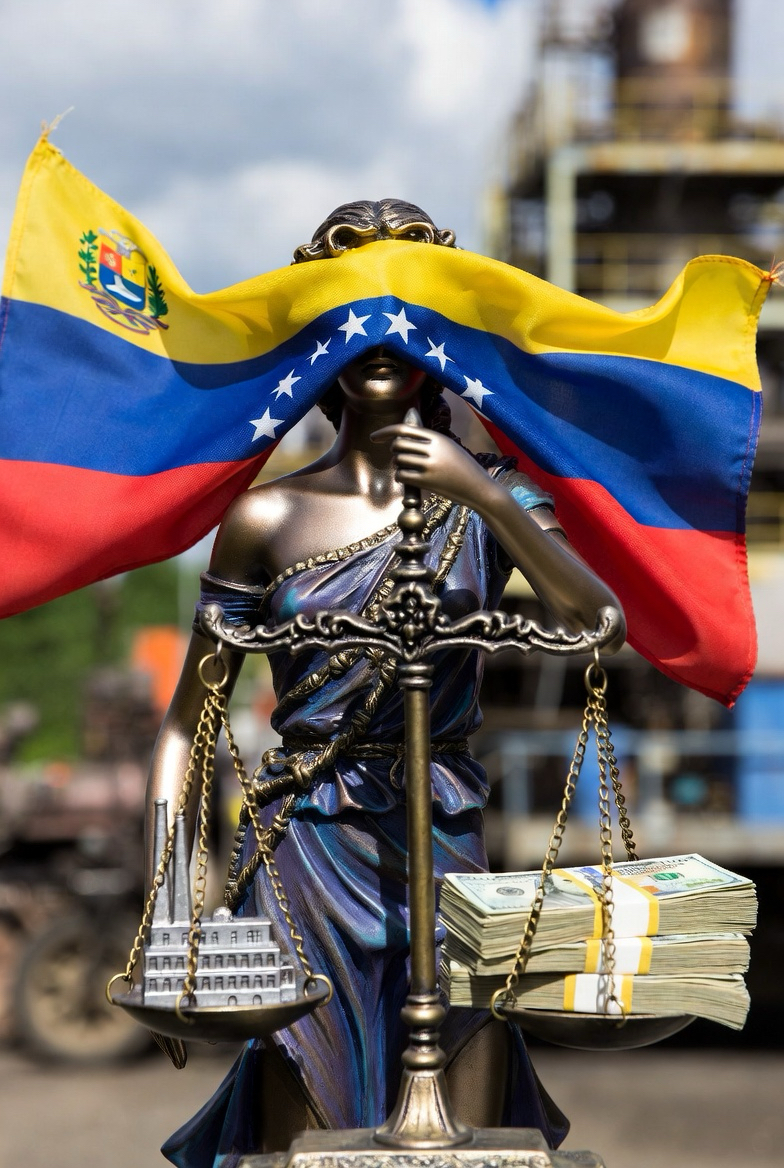
For twenty-six years, Venezuela has lacked institutions in any meaningful sense. The rule of law was progressively replaced by a criminal apparatus that preserved legal forms while emptying them of substance. In this context, continued appeals to procedural purity as the source of legitimacy amount to confusing normative appearance with real legal order. As Hans Kelsen warned, «the formal validity of a norm does not exhaust the question of its efficacy nor its integration into a system capable of generating legitimate obedience».
This is where the concept of the state of exception becomes relevant—not as arbitrary license, but as a response to radical abnormality. Carl Schmitt expressed it bluntly: «sovereign is he who decides on the exception». Venezuela’s tragedy has been an exception without an ordering decision. The result was not constitutionalism, but domination: neither law, nor politics, nor effective sovereignty.
Trump’s strategy introduces, for the first time in years, a structuring decision, and—crucially—a demonstrated capacity for execution, as evidenced on January third. It does not seek to morally legitimize the existing Venezuelan power structure. It seeks to functionally subordinate it to an external reconstruction plan.
The legitimacy of norms does not necessarily depend on the legitimacy of the internal power from which they formally emanate, when that power operates under a strategic tutelage aimed at restoring the state. In exceptional situations, legitimacy shifts from origin to purpose. A norm is legitimate not because of who signs it, but because of what it dismantles and what it makes possible.
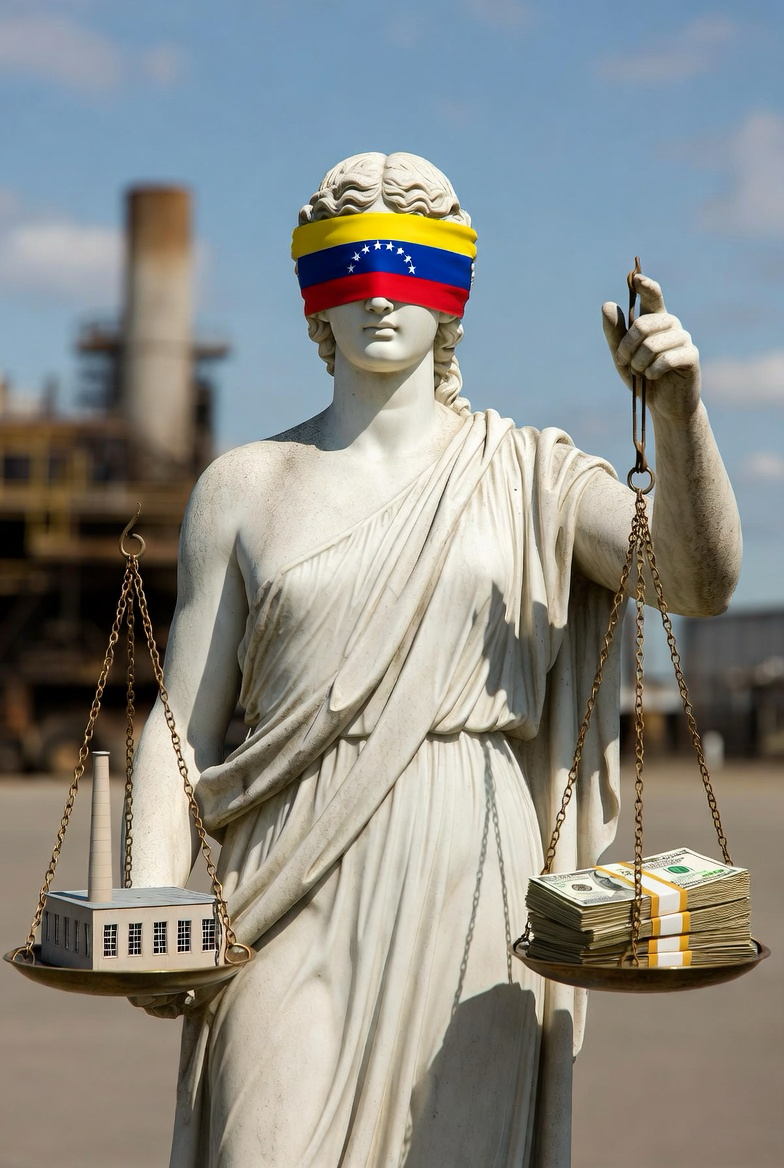
For this reason, in the Venezuelan case, laws and decisions authorized, endorsed, or integrated into Trump’s plan are legitimate, even if the Venezuelan authority from which they formally derive is not. The source of legitimacy is not the hollowed-out local institutional shell, but the verifiable alignment with a project designed to dismantle the criminal system and reconstruct institutional order. The criterion is material: order, security, economic recovery, justice, and the creation of real conditions for a future democracy.
Hannah Arendt helps close the circle: «genuine power is not identical with naked violence; it arises when an order takes root and produces obedience no longer dependent solely on fear». Legitimacy appears when reconstruction ceases to be mere coercion and becomes viable civil life.
Postwar Reconstruction as Precedent
This logic is neither novel nor foreign to Western political tradition. The reconstruction of Germany, Japan, and Italy after the Second World War did not rest on fully legitimate internal sovereignties or on democratically validated authorities at the outset. On the contrary, those processes were driven by external tutelary powers that imposed transitional legal frameworks, reorganized institutions, purged judicial and military apparatuses, and reactivated devastated economies.
In Germany, the foundational norms of the postwar order did not emanate from a fully legitimate German sovereignty, but from Allied authority that conditioned, supervised, and directed institutional reconstruction. The legitimacy of that process was not antecedent—it was a consequence of its success. The same was true in Japan, where constitutional and administrative reorganization occurred under external supervision that no serious observer would dismiss as illegitimate merely because it did not arise from intact national sovereignty. Italy followed a similar path.
In all these cases, legitimacy did not reside in the formal origin of norms, but in their capacity to produce order, stability, prosperity, and eventually real democracy. The state was reconstructed first; normal politics came later.
Why Trump and His Team Have the Legitimacy to Direct Change in Venezuela
Within this framework, the legitimacy of Trump and his team to lead the Venezuelan process rests on three interconnected elements:
- Real capacity for decision and execution, demonstrated by the January third operation: planning, command, deployment, and results.
- A reconstructive purpose: not managing collapse, but reversing it through sequenced phases that restore the minimum conditions of political life—census, electoral registry, identification systems, judicial and electoral purification, territorial control, border security, and economic reactivation.
- The absence of substantive internal legitimacy: after decades of simulation and coercion, Venezuelan formalism is incapable of generating legitimacy on its own. In that anomaly, effective direction falls—inevitably—to the only actor with sufficient power to impose a transitional framework of reconstruction.
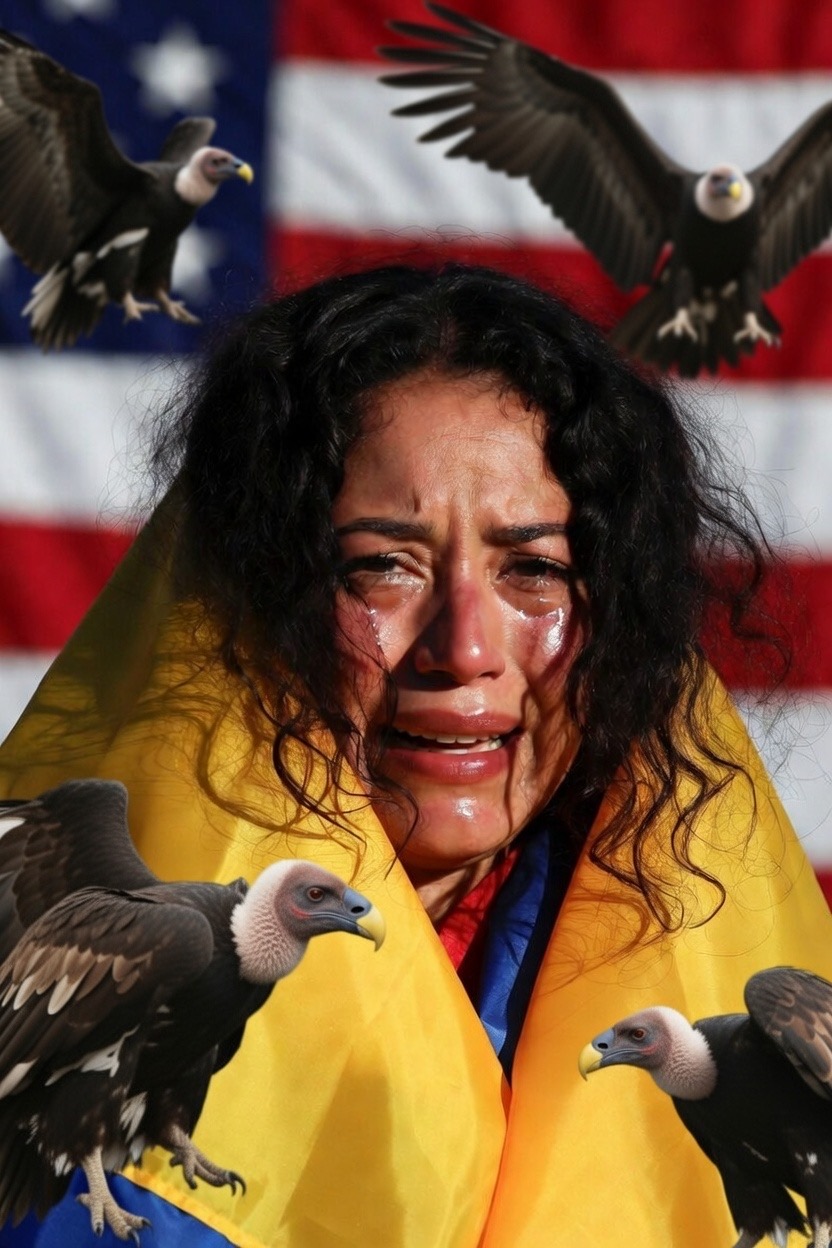
This is why the “Oslo resentful crowd with their pro-loot club of ravenous vultures” must be stopped. Their insistence on immediate elections without conditions is not democracy; it is the reproduction of fraud. To this chorus are added not only certain European formalist circles, but also sectors of the Latin American left and the U.S. Democratic Party, for whom the success of the plan would be politically intolerable. They would rather see Venezuela remain in a cesspool than allow Trump’s strategy to succeed.
In prolonged states of exception, legitimacy is neither inherited nor proclaimed—it is built. And today, in Venezuela, that construction depends on method, capacity, and sequence—already demonstrated—by Trump and his team. Denying this in the name of an abstract democracy does not elevate the argument morally; it merely prolongs the collapse.



Deja un comentario