
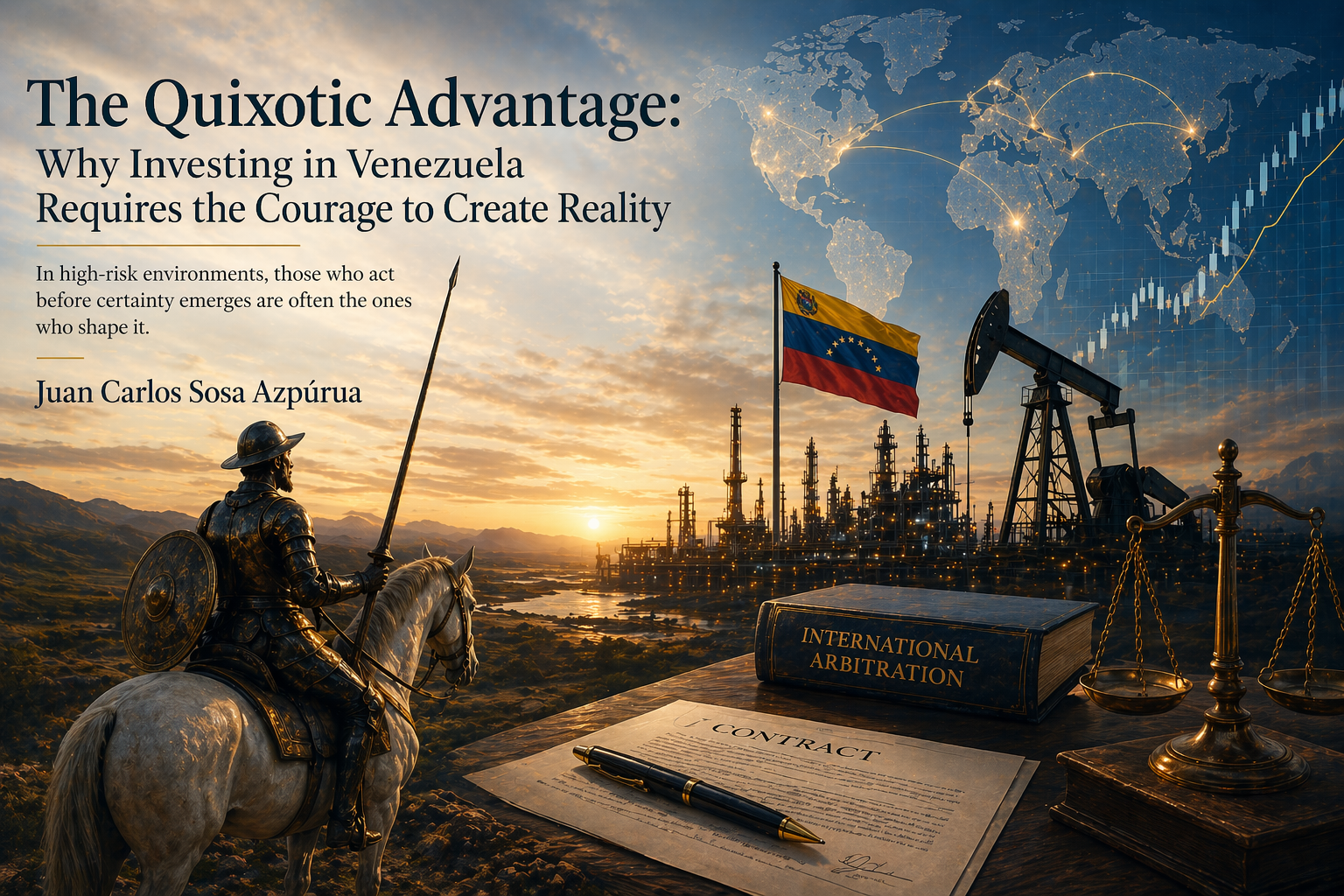
In high-risk environments, those who act before certainty emerges are often the ones who shape it.
By Juan Carlos Sosa Azpúrua
In global investment circles, Venezuela is often framed as a paradox: a nation of vast natural wealth constrained by institutional fragility. For many, this contradiction is reason enough to stay away.
But history suggests a more nuanced conclusion. Periods of institutional ambiguity have often been the very conditions under which transformative investments are made. From early oil concessions in the 20th century to post-war reconstruction efforts across Europe, capital has rarely waited for perfection. It has moved where opportunity demanded vision.
This is where an unexpected figure becomes relevant: Don Quixote. Miguel de Cervantes’s protagonist is often dismissed as delusional. Yet a deeper reading reveals something else: a man who refuses to be confined by the apparent limits of his environment. Don Quixote does not deny reality, he challenges its inevitability.
That distinction matters. In today’s Venezuela, investors face a similar psychological threshold. The question is not whether risks exist, they do. The question is whether those risks are static, or whether they can be mitigated, structured, and, in time, transformed.
Modern investment is not passive exposure; it is engineered participation. Legal frameworks, particularly in the energy sector, have evolved in ways that allow for sophisticated risk management. International arbitration mechanisms, contractual protections, and external enforcement structures now provide tools that were simply unavailable in earlier eras of resource development.
This changes the equation. Rather than waiting for a fully consolidated institutional environment, investors can operate within a structured architecture that anticipates volatility. In doing so, they are not merely adapting to risk, they are shaping the conditions under which stability can emerge.
There is precedent for this approach. Major energy developments across the world, from frontier basins in Africa to post-conflict regions, have often begun under conditions far from ideal. What distinguishes successful entrants is not their tolerance for risk alone, but their ability to pair vision with legal and financial discipline. In this sense, the “quixotic” investor is not irrational. He is strategic.
He understands that markets, like societies, are not static constructs. They are dynamic systems influenced by capital, law, and narrative. And those who engage early, intelligently and deliberately, often become stakeholders not just in profit, but in transformation.
Venezuela today presents such a moment. Its resource base is unquestionable. Its challenges are real. But so too is the possibility of reconfiguration legal, economic, and institutional.
To engage under these conditions requires more than capital. It requires a particular mindset: the willingness to act before consensus forms, to build within uncertainty, and to recognize that reality, in many cases, is not merely discovered—it is created.
That was Don Quixote’s insight. And, in a different context, it may well be the investor’s advantage.


Deja un comentario