
Three scenarios stand before Trump, and none of them flatters him.
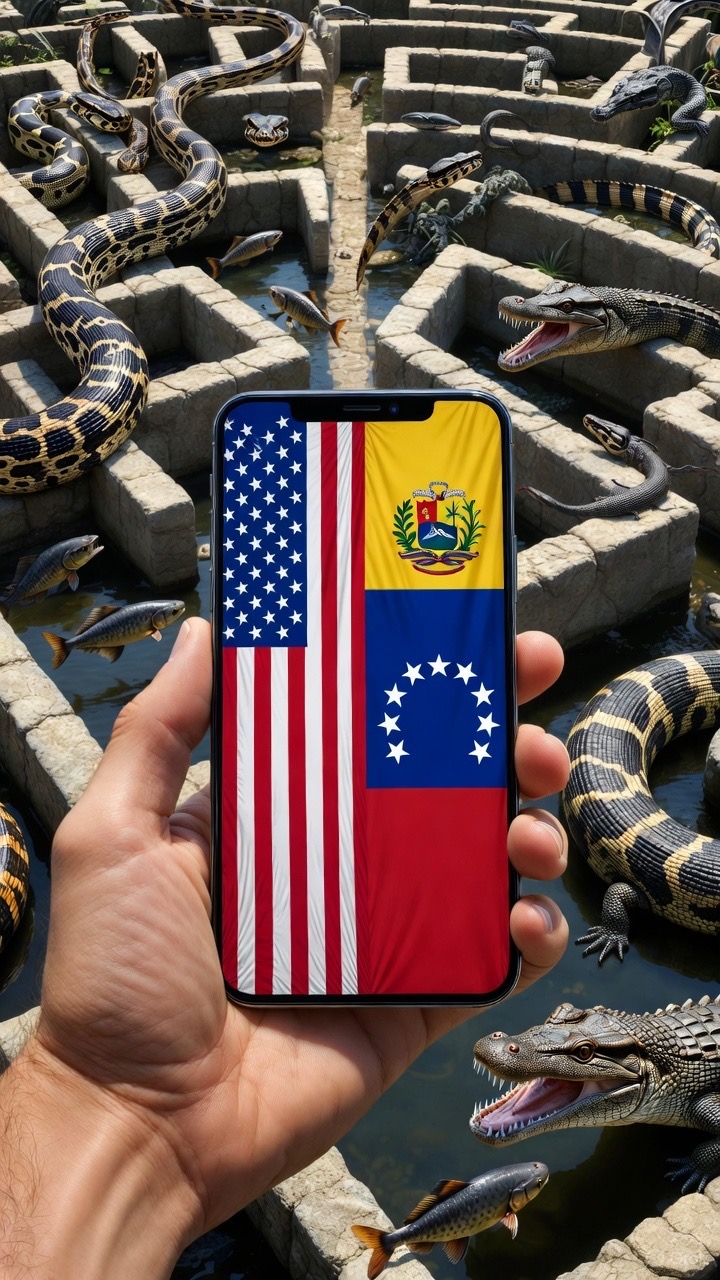
The first: the invasion of Venezuela. A madness of colossal proportions. It would mean venturing into a labyrinth without exit, against insurgent forces trained in guerrilla warfare, across a vast territory—three times larger than Vietnam, twice the size of Iraq, and a third larger than Afghanistan—threaded with swarming cities, Amazonian jungles, snowcapped mountains, and rivers dense with caimans, anacondas, and piranhas.
The second scenario: withdrawal. To pull back the ships from the Caribbean and return to daily routine with one’s tail between one’s legs. Unlikely, given the need to assert territorial hegemony in the face of China and Russia.
The third: negotiation with the Maduro regime, followed by the construction of a triumphalist narrative—steeped in theatrical rhetoric and the usual lies costume-dressed as truths. This is the winning scenario and it is already in motion. For the first would have meant reopening a ledger of failures and open wounds that no one in the United States wishes to revisit. In Vietnam, Iraq, and Afghanistan, that nation folded its tent after two decades of death in each land—resolving nothing and complicating everything.
After the Trump–Maduro phone call, several facts slipped past the smoke merchants and the segment of society given to self-deception and magical thinking, nourished by fake news and click-driven mercenary journalism. The scandalous closure of airspace proved to be yet another variable in a bluff that never deceived a regime schooled in every ruse.
We must recall that this is an intelligence apparatus that has sustained power for 108 years in Russia, 66 in Cuba, and 26 in Venezuela. If anyone might lecture Machiavelli and Sun Tzu, it is a regime whose medals of honor include surviving every war of the twentieth century and what we have lived of the twenty-first; surviving the missile crisis and every economic strangulation attempted across generations of ropes and guillotines that served no purpose—since the only necks tightened and heads that fell were those of innocent peoples with no candle in those funerals.
Days ago, a plane landed in Maiquetía from the United States, carrying Venezuelans with broken hearts and the American Dream in ruins. Another aircraft arrived from Mexico with passengers marked by the same fate.
In both cases, the cause was the same: the famous phone call—apparently also the guarantee that Chevron’s concession would become permanent and more aggressively extractive.
It is likely that further surprises will soon emerge regarding the positioning of U.S. commercial interests on Venezuelan soil. This responds to the imperatives of Realpolitik, so distant from the fantastic delusions and childish dreams of a national leadership that never understood the nature of the problem it held in its hands.
This reinforced U.S. presence will be tolerated by China and Russia, eager to restore a measure of Venezuela’s economic health—health that ultimately translates into better odds of honoring credit obligations and continuing the purchase of war machinery through juicy contracts that swell the mafias’ coffers across the continents.
The United States will come to accept that we now inhabit a multipolar world, where economic sanctions are circumvented through alternative axes of influence that lend financial and commercial channels so the sanctioned may survive and bind themselves to geopolitical and economic interests.
This third scenario does not leave Trump unscathed either, yet it spares him the immeasurable cost of the first and the humiliation of the second. Since the first fishing boat was blown apart three months ago, we argued that such an act annihilated the moral force of the struggle and placed the credibility of the U.S. government in check.
Facts are facts. After twenty-two vessels bombed and more than eighty people summarily executed—without evidence, without trial, without context—the Trump administration now faces the specter of a justified court-martial of its Secretary of War for grotesque crimes without any moral or legal excuse.
The Secretary of State, Marco Rubio, fares little better. Descended from Cubans, and now enlisted in the inhumane migratory raid ordered by his chief, he fell into the frivolous web of a political generation that bartered the destiny of a nation for ill-gotten wealth.
A political class that betrayed the soldiers it abandoned to their fate in Colombia, and made pirate loot of humanitarian aid, of Citgo, and of Monómeros—so as to live in exile like the rich and famous, parking Ferraris and Lamborghinis before the Monte Carlo Casino.
The same class that enthroned a semi-illiterate man with a chavista past and marmot-like motor skills as “legitimate president,” and that now dreams of governing Venezuela as though it were a scorched plain fit for the landing of a spaceship full of “extraterrestrials,” bearers of magical formulas meant to erase twenty-six years of betrayal, excess, and death in a hundred days.
It was this same class that persuaded Marco Rubio and a handful of Cuban-American senators that Venezuela harbors Armed Forces merely waiting for a credible threat in order to fracture and welcome a new government.
That failed intelligence is what led Trump into a trap from which he now struggles to emerge with dignity intact. His strategy of turning the Caribbean into a fearsome beast meant to terrify the chavista regime detonated in his own hands—thanks to his impulsiveness, stoked by the mediocrity of his advisers.
Soon these three months of uncertainty and media smoke will fade into yesterday’s noise. It will be said that Maduro agreed to cooperate in the war on drugs. It will be said that lives were spared by averting escalation. And it will also be said—truthfully—that Venezuela lacks a political class capable of steering a nation besieged by evil from every side.
New political exiles will follow the old, completing the circus of the absurd that entertained Venezuela while it was being destroyed.
The price was steep: the hope of a desperate people was wagered like a chip on a gaming table. They were treated with irresponsibility and contempt, for love does not consist in deception—nor in confusing delirium and fantasy with reality.
What must finally be accepted is that the regime in power is not there by accident. It is the natural product of a society that has refused to assume its own share of responsibility and prefers fairy tales to the raw face of truth.
If it is any consolation—and it hardly is—there will at least be peace, and the chance to build a life without bombs falling from the sky to reduce everything to rubble and deepen evils without solving any of them.
Many years will pass before even the faintest outline of an ideal change appears. But perhaps society may begin to learn from its errors, educate itself with seriousness, and—through painful effort—aspire, at last, to become adult




Deja un comentario