
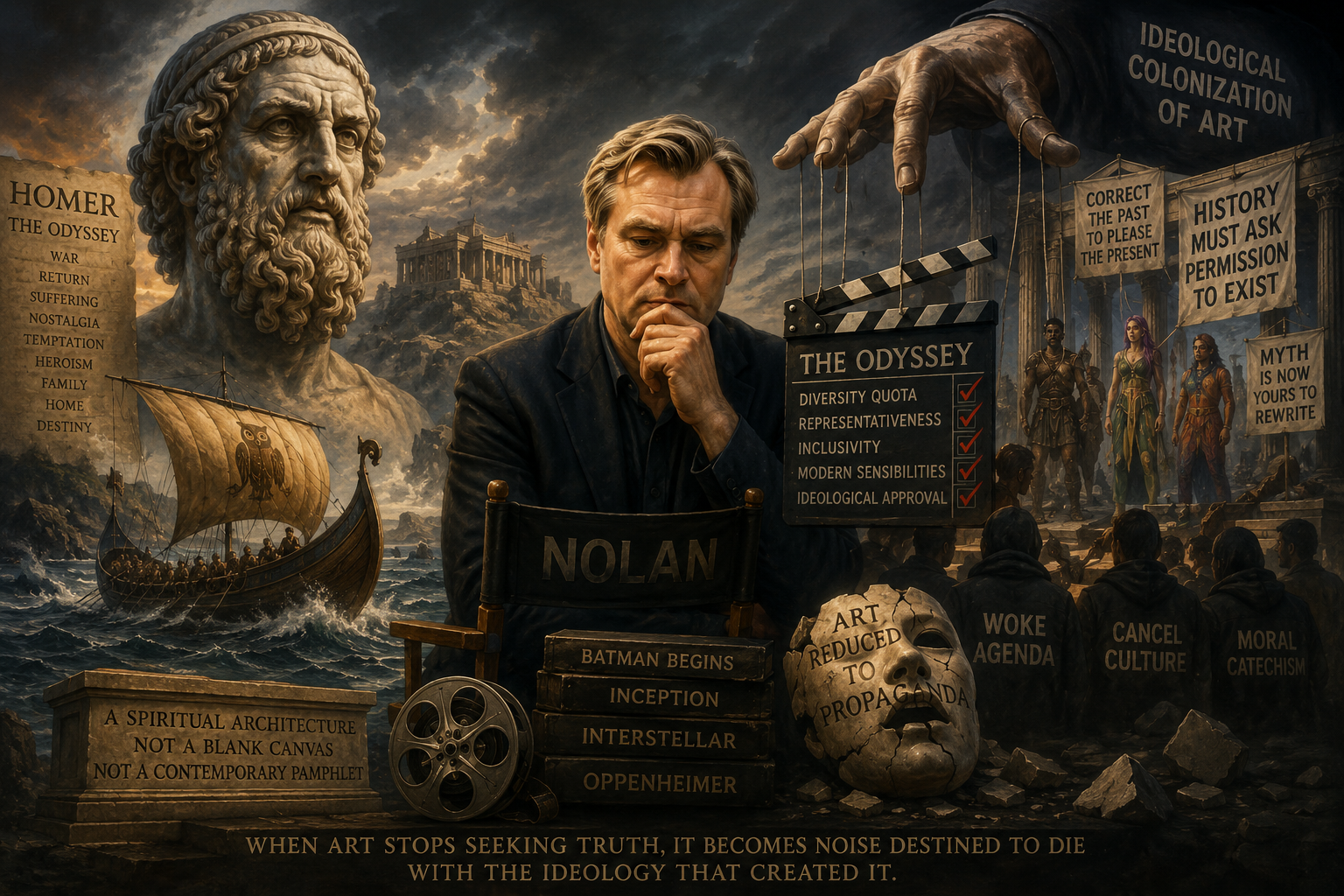
Christopher Nolan has proven himself to be one of the very few contemporary directors capable of reconciling mass cinema with great intellectual ambition. In an era dominated by visual banality, empty speed, and the infantilization of the audience, Nolan has achieved something extraordinary: restoring to commercial cinema its aspiration toward transcendence. His films: the Batman trilogy, Inception, Interstellar, Oppenheimer, are not mere audiovisual products; they are philosophical artifacts, meditations on time, chaos, guilt, sacrifice, destiny, and the human condition. Nolan understands something essential in these films: the audience does not need to be treated like idiots in order to be emotionally moved.
That is why the very idea that a creator of such stature might be willing to allow The Odyssey, one of the spiritual pillars of the West, to be subjected to the ideological demands of contemporary political correctness, produces bewilderment and sadness. And this is not a superficial discussion about casting preferences or modern sensibilities. The problem runs far deeper. It concerns the integrity of the work of art itself and the respect owed to the symbolic structures conceived by its creator.
Homer did not produce a contemporary pamphlet. He sang a foundational poem about war, return, pain, nostalgia, temptation, rebirth through suffering, heroism, family, home, and the tragedy of man confronted by destiny. The Odyssey is not an empty canvas upon which each generation may arbitrarily project its political obsessions. It is a spiritual architecture responding to a specific worldview: that of the archaic Greek world, with its values, contradictions, hierarchies, and symbols.
To modify that structure in order to introduce contemporary ideological agendas does not constitute artistic modernization. It constitutes hermeneutical distortion. Every great work possesses an ontological core that grants it internal coherence. To alter it is to fracture the symbolic logic that sustains the creation. When this occurs, the result is not a genuine reinterpretation, but an aesthetic mutilation disguised as moral virtue. Art ceases to be art and becomes ideological pedagogy.
This is one of the great cultural evils of our time: the substitution of aesthetic experience with emotional indoctrination. The “woke” agenda, understood not as legitimate human sensitivity toward real injustices, but as a dogmatic apparatus obsessed with rewriting all of history through contemporary ideological categories, begins from an authoritarian premise: the past must ask permission from the present in order to exist. Under this logic, no classical work may be contemplated according to its own historical, cultural, and symbolic codes. Everything must be corrected, sanitized, and adapted to the new moral catechism.
But art does not survive when it is forced to submit to catechisms. Great works are born from creative freedom, from the artist’s radical autonomy in the face of external impositions. Cervantes did not write Don Quixote to satisfy university departments of diversity and inclusion. Shakespeare did not subject Hamlet to contemporary ideological filters. Dante did not request moral authorization to structure his Inferno. Wagner did not compose The Ring of the Nibelung with postmodern sensitivities in mind. The authentic artist creates from an inner necessity, not from fear of being cancelled.
That is why it is so painful that Christopher Nolan, one of the last filmmakers capable of taking the intelligence of the audience seriously, appears willing to concede ground to this tendency toward the ideological colonization of art. Nolan had always understood the power of myth. Batman Begins is not a superhero film; it is an exploration of fear and the construction of the symbol. Inception reflects upon the illusory nature of reality and guilt as a mental prison. Interstellar transforms science fiction into a metaphysical elegy about love and time. Oppenheimer examines the Promethean tragedy of the man who steals fire from the gods and then contemplates in horror the consequences of his own genius.
There is in Nolan an almost religious reverence for the tragic grandeur of human stories. And that is why it is disconcerting to imagine The Odyssey subordinated to the bureaucratic logic of contemporary cultural progressivism, where what matters is no longer the aesthetic truth of the characters, but the statistical representativeness of the cast and the ideological conformity of the narrative.
When the audience perceives that a work of art has been intervened upon in order to satisfy external agendas, poetic suspension collapses. The artifice becomes visible. The creation ceases to breathe organically. The viewer no longer feels he is contemplating a universal human tragedy, but rather a moral lecture disguised as entertainment. And then emerges the worst artistic sin possible: falsehood.
The problem does not lie in updating readings or reinterpreting symbols. That has always occurred throughout the history of art. The problem arises when reinterpretation ceases to serve the work itself and instead begins using it as a propagandistic vehicle for external causes. At that point, the original creator disappears and is replaced by the ideological bureaucrat.
It is often claimed that every artist has the right to interpret a work of art, and that is true and inevitable, since each individual perceives reality in his own way. But interpretation is one thing; changing cultural signifiers and an entire spatiotemporal worldview is something entirely different. That is not interpretation. That is disrespecting the artist and destroying his work of art. It is akin to placing in art books an obese and dwarf-like David by Michelangelo, or a Parthenon fitted with bulletproof glass. Michelangelo conceived his sculpture with physical proportions carrying concrete meanings, and that was precisely his intention: to embody a specific notion of harmony and equilibrium. As for the Parthenon: there was no bulletproof glass in that era. There is no possible defense for the “woke” agenda. It represents the destruction of culture and thought itself.
This phenomenon may also be observed in Bayreuth, the Wagnerian temple conceived by Richard Wagner as the materialization of the Gesamtkunstwerk: the “total work of art,” where music, scenography, dramaturgy, lighting, and symbolism converged into an indivisible organic unity. Wagner understood that aesthetic experience had to be immersive, almost liturgical. Everything was designed in service of the work itself.
Yet much of contemporary Bayreuth has been colonized by postmodern reinterpretations obsessed with destroying precisely what made Wagner’s vision unique. Mythic symbolism is replaced by opportunistic political provocations; heroic scenography by deconstructive irony; transcendence by activism. The result is often grotesque: characters conceived to embody metaphysical archetypes are reduced to contemporary sociological caricatures.
This is not artistic evolution. It is conceptual disintegration. The tragedy of our time lies in the fact that many cultural elites no longer admire great works; they now wish to correct them. They no longer seek to understand them within their own context, but to discipline them from the standpoint of the present. The problem is that when a civilization loses the ability to listen to its classics on their own terms, it begins amputating its spiritual memory. And a culture without memory becomes propaganda.
True art unsettles, contradicts, provokes, and often reflects values different from our own. That is one of the reasons it survives across centuries. It forces us to dialogue with other eras, other sensibilities, and other moral universes. To destroy that alterity in order to transform every creative work into an ideological mirror of the present constitutes a sophisticated form of cultural barbarism.
Homer does not need to be corrected. Wagner does not need to be reeducated. Cervantes does not need to be sanitized. And Nolan, if he truly believed in the power of art as a transcendent experience, should not lend himself to transforming The Odyssey into a vehicle subordinated to the ideological neuroses of our age. Homer refers to Helen as the woman of “white arms” (λευκώλενος Ἑλένη) in the Iliad, Book III, and in the Odyssey, Book IV. In Archaic Greece, feminine whiteness symbolized delicacy, aristocratic femininity, and divine luminosity. A Kenyan actress may convey beauty, femininity, nobility, and many other qualities, but such casting ruptures a cultural understanding intrinsic to the era and explicitly embodied by Homer in his poems.
One cannot alter the culture and worldview of an epoch in order to satisfy a political agenda. That is the destruction of art, of the history of knowledge, and of culture itself. It is an act of corruption and intellectual dishonesty deserving condemnation. It is the destruction of ethics and respect for the past.
And this is not a matter of racism. It is a cultural issue. It would be like casting Brad Pitt to portray Martin Luther King Jr., or Angelina Jolie to play Rosa Parks. An absolute absurdity that shatters the cultural signifiers through which humanity understands its own history. What sadness that Nolan should descend into the sewer of the “woke” agenda, an agenda of sociocultural engineering seeking to dominate the world by making people intellectually stupid.
Because when art ceases to pursue aesthetic truth in favor of political approval, it ceases to be art and becomes historical noise destined to perish alongside the ideological fashion that gave birth to it.


Deja un comentario