
There are moments in the history of nations when forms cease to be mere forms and become substance, and Venezuela is living through one of them. After twenty-seven years of institutional destruction, the plundering of public resources, the deterioration of the oil industry, the collapse of the electrical system, mass emigration, and the progressive disappearance of the rule of law, our nation is finally beginning to perceive something that for far too long seemed like an abstraction: the possibility of a future.
The opportunities now opening up are enormous. We possess oil, gas, minerals, a privileged geographic location, some of the most fertile lands on the planet and the finest climate, water resources, recoverable infrastructure, a formidable professional diaspora and, more important than all of the above, an entire nation waiting to be rebuilt. Where others see ruins, the shrewd investor manages to see opportunities.
The deterioration of Venezuela is (what a paradox!) a measure of its potential. Every missing megawatt represents a possible investment; every destroyed road, a project; every deteriorated oil facility, an opportunity for recovery; every deficient water system; every hospital; every port; every airport; every school; and every abandoned industry, each constitutes a chapter in a gigantic national program of reconstruction. And the movement is already becoming noticeable. The oil industry is once again attracting international interest, foreign companies are studying new operations, and the energy link with the United States is acquiring a dimension that would have seemed like fiction only a few months ago.
And precisely because the opportunity is so vast, the threat of starting off on the wrong foot is a latent and highly dangerous risk. During political transitions there exists a diabolical temptation: to believe that pragmatism justifies any company, and it does not. I understand perfectly well that the United States maintains open channels with certain figures from the old regime; it may even prove indispensable (see my previous article: THE WRONG DUEL).
Tyrannical systems do not disappear through collective enlightenment; they fracture. Their elites negotiate, internal contradictions appear, some sectors discover that surviving the system is more convenient than dying with it, and, when the moment arrives, the structure begins to collapse from within. History is full of examples. Successful democracies were not always born through an absolute rupture; many times they were the product of an intelligent combination of external pressure, internal negotiation, guarantees, and the gradual dismantling of authoritarian structures. That is why it would be naïve to demand that Washington deal only with the «saints». International politics does not work that way.
A controlled implosion of the Venezuelan system requires interlocutors who yesterday belonged to the regime. If certain officials still hold effective control over institutions, the Armed Forces, the bureaucracy, oil, or security, negotiating with them is unpleasant, but necessary. That is called realpolitik. But it is something entirely different to import from abroad characters who are not even necessary to dismantle the regime and turn them into privileged intermediaries of the new Venezuela. That is where the error begins; that is where the cancer is inoculated.
In recent weeks the names of certain little characters belonging to the universe baptized as the “bolichicos” have reappeared in public conversation. And we cannot erase memory in so absurd a fashion. For millions of Venezuelans, the “bolichicos” became the symbol of an era: young vampires close to the regime who, while Venezuela suffered a devastating electricity crisis, sank their fangs into multimillion-dollar public contracts to transform themselves into tycoons, while leaving the country in darkness. Vampires who condemned everyone to live in obscurity while they dressed in suits of lights and bought castles and shell companies.
And this has political meaning. Because a national reconstruction needs something more than capital; it also demands a measure of legitimacy.What message can a Venezuelan businessman receive who for nearly thirty years survived without privileged contracts, paying taxes, keeping workers employed, and navigating controls, expropriations, and arbitrary measures, when he discovers that the doors of the new Venezuela are opening once again for some of the same gangsters responsible for the apocalypse of the country produced by the nuclear bomb of corruption they detonated?
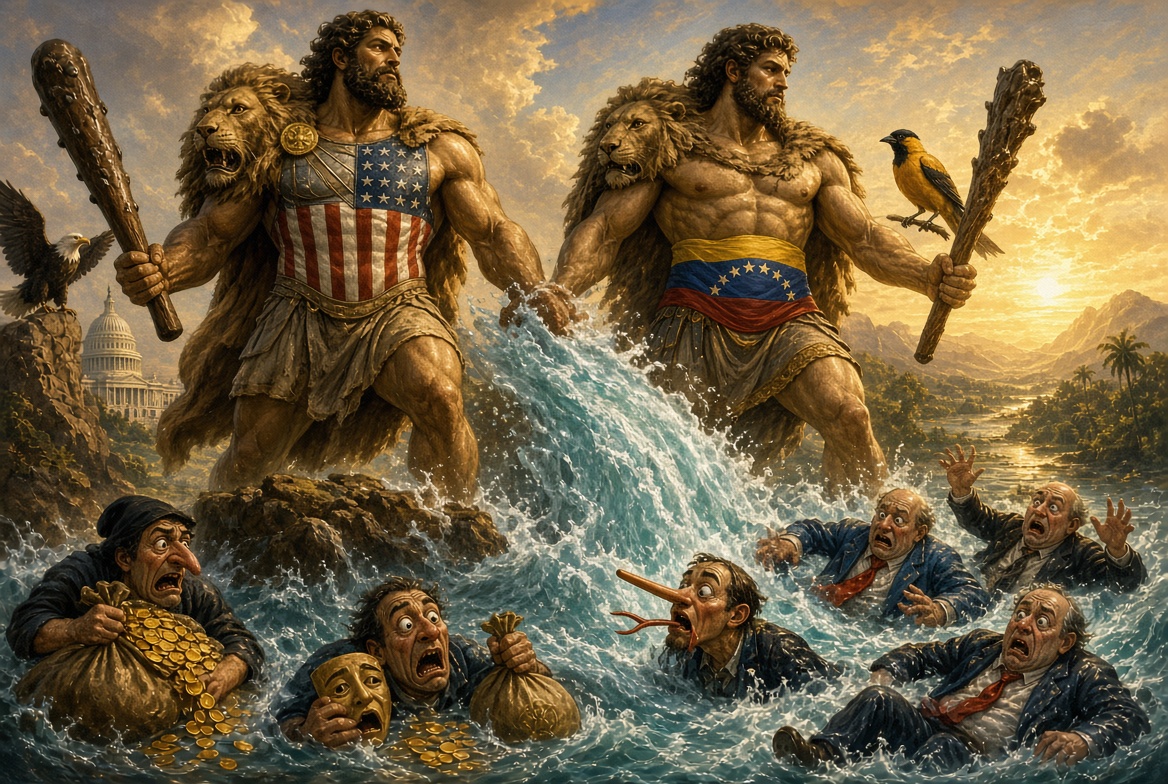
One of the labors of Heracles was to clean the stables of King Augeas, where a grotesque quantity of filth had accumulated over decades. The son of Zeus and Alcmene understood that this filth could not be cleaned by removing the waste one by one. So he diverted a pair of rivers and let the water flow through the stables. This metaphor is appropriate for Venezuela. After twenty-seven years it is not enough to change a few names on the doors of the ministries. It is imperative to send a mighty river through the institutions. And it would be ridiculous to divert the waters in order to clean the stables and then hire as administrators those who grew rich from the manure.
Venezuelan reconstruction must produce a visible ethical rupture. I am not referring to inquisitions or witch hunts. Nor to substituting one political exclusion for another. Freedom must guarantee due process, the presumption of innocence, property rights, legal security, and reconciliation. It is something much simpler: merit and transparency.
Washington should establish a pristine distinction between those who are tactically necessary to complete the dismantling of the old system and those who must become the strategic protagonists of the future Venezuela. They are different categories. It is necessary to negotiate with certain Chavista officials to facilitate the transition. It is indispensable to retain for a time certain technical cadres, and it is even intelligent to offer guarantees to sectors capable of obstructing the process violently.
But the builders of the new nation must be others. Venezuela has enough educators, lawyers, economists, engineers, doctors, businessmen, scientists, public administrators, oil specialists, and infrastructure experts, both inside and outside the country, not to need intermediaries whose mere presence generates suspicion, rage, and scandal.
Here lies an extraordinary opportunity for the United States. A stable, democratic, prosperous, and Western Venezuela is not an act of altruism. It is a formidable geopolitical interest of the United States, for we can once again become one of the principal energy suppliers of the Western Hemisphere; be an extraordinary market for companies; represent a factor of stability in the Caribbean / South America and, of course, transform ourselves into a natural long-term ally. For decades that is what occurred. Let us not forget that Venezuela came to be one of the most prosperous countries on planet Earth.
The United States should think of Venezuela not as a five-year oil operation, but as a strategic alliance forever. After 1945 Germany was a cemetery. Its cities lay in ruins, its infrastructure pulverized, millions displaced, its industry devastated, and a society traumatized with its self-esteem on the floor. Yet from those ruins emerged one of the most powerful economies on the planet.
The Wirtschaftswunder, the so-called “German economic miracle,” was not an act of magic. Behind it stood institutions, American aid, economic openness, monetary discipline, industrial reconstruction, and technically competent figures such as Ludwig Erhard. Countries are not rebuilt with money alone. They are rebuilt with institutions and people.
Japan, as I have written countless times, offers another extraordinary lesson. After Hiroshima and Nagasaki it seemed impossible to imagine that that archipelago reduced to shreds could, in the blink of an eye, become an industrial and technological power. Its culture possesses a beautiful image to explain it: “kintsugi», the art of repairing a broken piece of pottery by injecting gold into its fractures. The scars are not hidden; they are incorporated into the new beauty of the object, making it even more beautiful than before.
In Venezuela we will have to do something similar. Not pretend that these twenty-seven years never happened. They are there and form part of our history. But we can use our scars to build institutions designed to prevent such a tragedy from ever repeating itself. When the politically opportune moment arrives, we should seriously discuss the formation of a “National Reconstruction and Transition Board” that is neither a military junta, nor a distribution among parties, nor a table to satisfy personal appetites. It must be a temporary emergency structure composed of compatriots of recognized professional competence and moral solvency, accompanied by rigorous mechanisms of transparency and supervision.
We need human teams for the sectors of oil and gas; electricity; water; infrastructure; health; education; security; justice; monetary stabilization; public debt; recovery of assets; foreign investment; tax reform; administrative modernization; and democratic reinstitutionalization. Each of these areas should be directed by the best; and not by friends, party comrades, campaign financiers, or whoever happens to have the right telephone number in Washington. It must be the best, period. And when there are several candidates of equal competence, the one chosen should also possess a personal trajectory capable of generating trust. Because during Venezuelan reconstruction, life trajectory will be an economic asset.
Anyone who believes that major investors study only oil reserves and internal rates of return does not understand how international capital works. They also analyze who makes the decisions, who signs the contracts, which courts will resolve disputes, what rules exist for tenders, which anti-corruption mechanisms function, and who the intermediaries are.
Venezuela will need trillions of dollars in the coming years. And that money competes with opportunities existing in many other countries. Reconstruction, therefore, must begin by sending an unequivocal signal: the Venezuela of the shady deals is over.
What is required are accessible public contracts, transparent tenders, identified ultimate beneficiaries, international audits, conflict-of-interest rules, independent courts, absolute protection of private property (beginning by compensating the businessmen stripped of their companies by the Chavista decrees that were armed robbery), and zero magical intermediaries.
The businessman who wishes to invest must be able to sit down face to face with the Venezuelan State, know the rules, compete, and win if his proposal is the best, without godfathers. Troy resisted the attacks of the Achaeans for ten years. It did not fall before Achilles or before thousands of soldiers; it fell when it opened its own gates. The horse conceived by Odysseus seemed a gift, but inside it came the past armed to the teeth. Every transition contains its own Trojan horses: characters who change language and attire according to the winds. Old operators who suddenly discover the virtues of the free market. Subjects accustomed to prospering in the shadow of the State who suddenly become heralds of capitalism and the new times. Yes, we must open all the doors of Venezuela to capital. But it is wise to look inside the horse before letting it in.
There is also an ancient Chinese idea, the “Mandate of Heaven” (Tianming). Rulers retained legitimacy so long as they governed with justice; when corruption, disorder, and incompetence took hold of the kingdom, it was understood that they had lost that mandate. We need not adopt its supernatural dimension to grasp the extraordinary political intuition it contains.
No power manages to retain its legitimacy indefinitely when it destroys that which it was meant to protect. The old Venezuelan order lost its mandate long ago, and now the hardest task begins: to build another. And that is why we must take care with the beginning. Nations, like people, possess certain instants in which they can change their destiny. They are brief historical windows. If they are wasted, they may take generations to return.
Venezuela today has before it one of those windows: resources, location, talent, a prepared diaspora; an immense market to rebuild. We once again count on the interest of the great powers and of international capital. And we have something we had lost for far too long: hope.
Let us not squander it by repeating the habits that brought us here. Washington must understand that it is not only the destination that matters. It also matters who accompanies us on the journey, and the new Venezuela cannot begin by reproducing the photographs of the old one.
What must be rebuilt is something far more difficult: trust. Great nations also pass through darkness.
The important thing is to remember that dawn does not consist merely in the ending of the night. It consists in beginning a different day.


Deja un comentario