
by Juan Carlos Sosa Azpúrua
There are nights that belong to the spiritual destiny of a nation. Evenings where an artistic event transcends performance and becomes symbol, augury, the announcement of a historical resurrection.
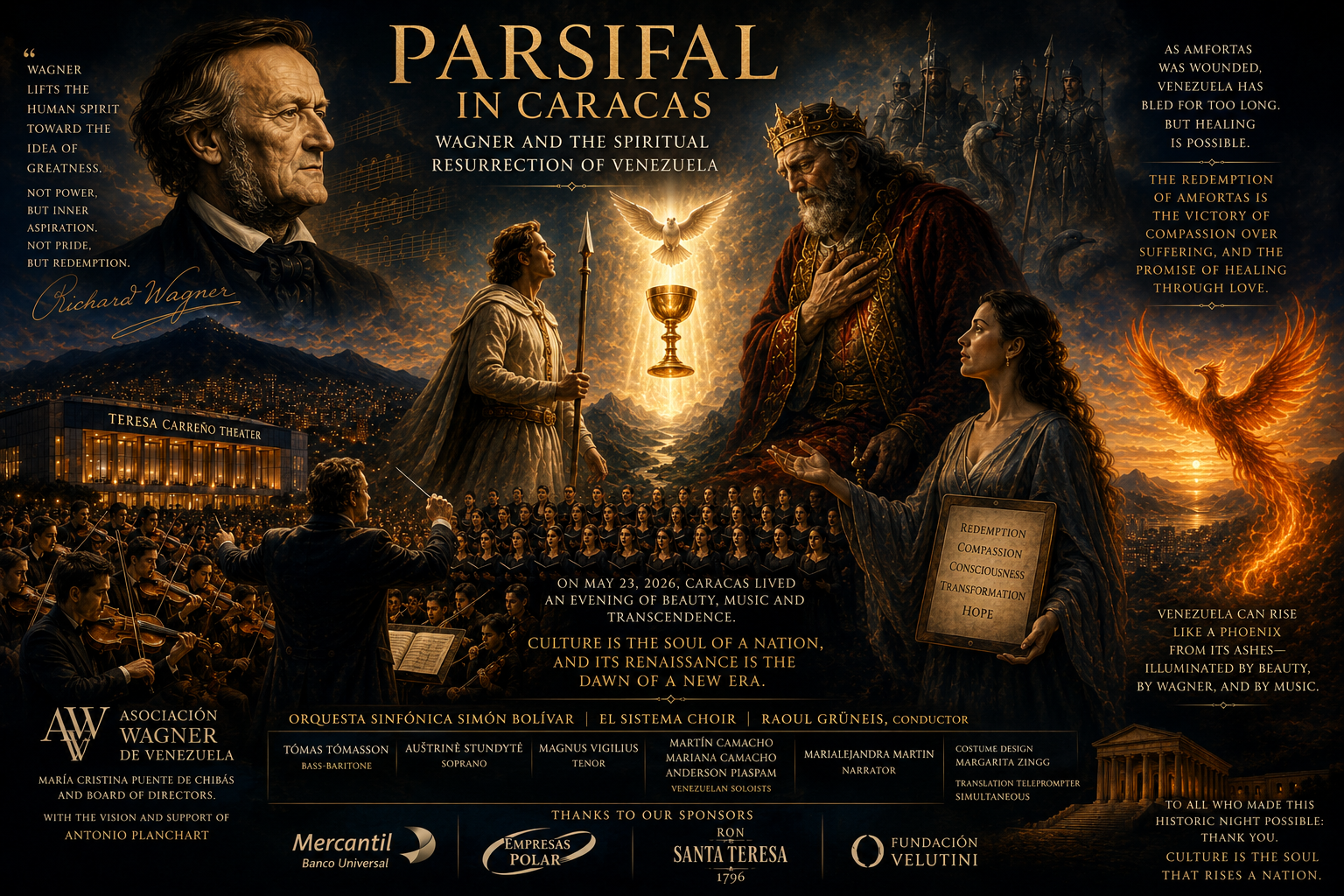
The presentation of Parsifal by Richard Wagner in Caracas this past Saturday, May 23, was precisely that: an act of collective elevation; an aesthetic and moral ceremony in which Venezuela once again contemplated itself not through the lens of ruin, but through the possibility of greatness.
What unfolded within the Ríos Reyna Hall of the Teatro Teresa Carreño was not merely a concert. It was the vindication of civilization as an act of resistance. The triumph of culture over resignation. A palpable demonstration that nations, too, possess a soul, and that such a soul can awaken and heal again even after enduring the deepest wounds.
From the very first chord, it became evident that we were witnessing a historic event. The Orquesta Sinfónica Simón Bolívar and the choir of El Sistema displayed flawless virtuosity worthy of the world’s great musical capitals. Every instrumental section breathed Wagner with remarkable maturity: the strings laden with metaphysical density, the brass solemn and ceremonial, the woodwinds imbued with that transcendent melancholy that transforms Parsifal into a spiritual experience.
And therein lay one of the evening’s greatest sources of pride: Venezuela accompanying with excellence some of the most important Wagnerian interpreters on the contemporary international stage. There was neither insecurity nor any sense of cultural periphery. For several hours, Caracas felt like one of the musical capitals of the world.
German conductor Raoul Grüneis led with moving passion, infusing the atmosphere with an energy that inspired the finest qualities of every musician on stage. Icelandic bass-baritone Tómas Tómasson, Lithuanian soprano Auštrinė Stundytė, and Danish tenor Magnus Vigilius, joined by Venezuelan performers Martín Camacho, Mariana Camacho, and Anderson Piaspam, delivered interpretations of immense vocal and dramatic force.
Each understood that Wagner demands far more than voice alone: he demands embodiment. He requires the entire body to become symbol. And that is precisely what occurred. The characters did not appear “performed,” but possessed by myth itself. Humanity, suffering, mysticism, and redemption inhabited every gesture, phrase, and glance.


The histrionic power of the soloists allowed even those unfamiliar with the work in its entirety to penetrate its essence through profound emotion. For Parsifal is not experienced solely through hearing: it is absorbed through consciousness itself and vibrates within the soul’s most sensitive chambers.
The choir reached moments of overwhelming majesty. Wagner understood like few others the ceremonial power of the collective voice, and that liturgical dimension was conveyed masterfully. There were passages in which the sound seemed to emerge not from a stage, but from a cathedral suspended beyond time itself. The choir did not accompany the work: it elevated it.

Another element resolved brilliantly was the teleprompter featuring simultaneous translation. Restrained, legible, and never intrusive, it allowed the audience to follow every instant of the drama without sacrificing aesthetic immersion. That difficult balance between accessibility and refinement was handled with extraordinary intelligence.
And there emerged one of the production’s greatest artistic triumphs: synthesis. Although the complete opera was not performed, there was never any sensation of mutilation or reduction. The production succeeded in encapsulating the spiritual and dramatic essence of Parsifal with perfect coherence. The work preserved intact its metaphysical pulse, emotional architecture, and monumental symbolism. Such a feat is only possible when there exists a genuine understanding of Wagner’s spirit — and the reverence to honor it accordingly.
The narrator, portrayed by the gifted Marialejandra Martín, represented a conceptual triumph for the production and a subtle nod to the genius of the theater of Periclean Greece. Far from interrupting the dramatic flow, she articulated and enhanced it. Her presence condensed the temporal leaps, symbolic complexities, and spiritual evolution of the characters, offering the audience an elegant and intelligent guide. At no point did she feel artificial or imposed: she became an organic bridge between Wagner’s philosophical monumentality and the contemporary sensibility of the spectator. Thanks to her, the narrative synthesis acquired cohesion, breath, and continuity.

The costume design by Margarita Zingg was equally remarkable: sober, elegant, and deeply respectful of the work’s mythical, historical, and cultural universe. It avoided the “progressive” excesses and narcissistic reinterpretations so common in certain contemporary productions, and that restraint was deeply appreciated. She understood something essential: when myth possesses genuine power, it does not need to be distorted in order to appear “relevant.” It need only be served with intelligence and sensitivity.

All of this was made possible through the titanic efforts of the Asociación Wagner de Venezuela, of María Cristina Puente de Chibás, and of its board of directors, whose work represents a true act of love toward Venezuelan culture. The impulse and vision of Antonio Planchart, as an admiring board member of the association commented to me, also deserves a standing ovation. His perseverance proved vital in bringing a production of such magnitude into existence.


It is also important to acknowledge the sponsors, among them Mercantil Banco Universal, Empresas Polar, Ron Santa Teresa, and Fundación Velutini, whose support demonstrates that the private sector can become a custodian of the national spirit when it understands that supporting culture is not decorative philanthropy, but an investment in civilization itself.



I found it impossible to ignore the magnificent state of preservation of the Teatro Teresa Carreño, the courtesy and professionalism of its staff, and the meticulous organization of the entire experience. It conveyed a peculiar sensation to those of us who have endured years of national deterioration: the sensation of civilized normalcy. The emotion of perceiving that Venezuela can function once again. The hope that the country is slowly beginning to rediscover itself.


And within that context, Parsifal acquired an even more powerful symbolic dimension. The redemption of King Amfortas, wounded, diminished, condemned for years to endless spiritual agony, functions as a metaphor for Venezuela itself: a nation lacerated by decades of institutional destruction, social fracture, and collective despair, yet one that still preserves within itself the possibility of healing.
For the greatness of Parsifal resides precisely there: in affirming that redemption is born not from perfection, but from compassion, consciousness, and the ability to rediscover meaning through suffering.
Venezuela, like Amfortas, has bled for far too long. Yet perhaps the moment of healing is beginning to appear on the horizon.

Within this broader historical context, we should not underestimate the fact that certain recent geopolitical shifts and actions undertaken by the government of the United States since January 3 have contributed to generating new dynamics and possibilities that are now beginning to reverberate through the country’s psychological, economic, and cultural climate as well. Culture is often among the first spaces through which societies announce, even before politics does, that they desire to breathe again.
And Caracas breathed that night: it breathed beauty, order, transcendence, and civilization.
Because Richard Wagner, and Parsifal in particular, possesses that extraordinary capacity to elevate the human spirit toward the notion of greatness. Not greatness understood as vulgar domination or material arrogance, but as inner aspiration and moral conquest; as a call to transcend the spiritual dwarfism of the contemporary world.

In an age where political agendas and socio-cultural engineering seek to caricature Western civilization through an obsession with degrading the symbols that shaped its existence, relativizing excellence, and banalizing heroism, Parsifal reminds us that the human being also possesses the right to aspire to nobility, sacrifice, redemption, and light.
And perhaps that is why the experience of Saturday, May 23 proved so moving for Caracas. For several hours, Venezuela remembered that it may yet become like a Phoenix rising from its ashes: illuminated not by propaganda or shrillness, but by the genius of Wagner, by beauty, and by music.


Deja un comentario