
by Juan Carlos Sosa Azpúrua
On June 24th, a mere thirty-nine seconds apart, two earthquakes of magnitude 7.2 and 7.5 shook Venezuela’s central coast. Geology, which understands nothing of accumulated grief or political calendars, chose a country that had spent twenty-seven years waiting for someone in power to look downward with the same attention it reserves for a lifetime appointment.

La Guaira, Caraballeda, Catia La Mar, San Bernardino: names that until yesterday evoked beaches and balconies are today synonymous with rubble, with death tolls the government updates by the drop, thousands dead within a single week, tens of thousands missing that no official spokesperson dares to add up, and a question that is not only seismic but moral: how much of this tragedy belongs to tectonic plates, and how much to human negligence?

To the dead, to the wounded still overflowing field hospitals, to those who lost every object that gave shape to their memory: a house, a photograph, a piano, a collection of letters, we owe no geological explanations. We owe them, first, our deepest condolences, and after that, the whole truth. Let these words stand, above all, as an embrace to the survivors and a bow to those who will not return: may the earth that covered them someday be earth that bears fruit again. No earthquake is only natural. Venezuelan seismology says so in an act of honesty that politics rarely matches: the magnitude of the damage depends less on which fault ruptures: Boconó, San Sebastián, El Pilar, the three tectonic arteries that cross the country, than on the quality of what has been built above it.
Placed in perspective, June 2026’s double quake joins a list Venezuela has been keeping since 1530, when an earthquake destroyed the Spanish settlement in what is now Cumaná. It was followed by the San Bernabé earthquake of 1641; the one of 1766; that of 1812 (Holy Thursday, a devastating quake struck Caracas, La Guaira, Mérida, Barquisimeto, and San Felipe in the middle of the war of independence—between 10,000 and 26,000 dead by contemporary estimates, the deadliest of all); Cumaná’s in 1853; the Great Andean Earthquake of 1894; San Narciso’s in 1900 (7.7, it woke Caracas with a sixteen-foot tsunami on the coast, over a thousand dead, and a city that rose again); Cumaná’s again in 1929, with its tsunami of several meters; the Caracas earthquake of 1967 (6.5–6.6 near Caracas left between 245 and 300 dead and proved that even «modern» construction could fail if it did not respect antiseismic standards, lessons were learned, then forgotten under the weight of demagoguery and plunder); Cariaco’s in 1997; Carabobo’s in 2009; Sucre’s in 2018; and the Zulia-Lara double quake of 2025, a mere nine months before the ones we suffer today.
Each tragedy was also an opportunity. Each time, the Venezuelan people showed an almost superhuman resilience.
But the political class, in its various incarnations, rarely rose to meet that popular courage. Institutional memory weakened over the years, until the next tremor once again found buildings raised without rigor, on coastlines where prudence should have dictated other materials and other heights.
In 2026 that history repeated itself with an unprecedented aggravating factor: twenty-seven years of a State that dismantled technical capacity, drove away engineers, rewarded loyalty over competence, and governed through opacity as method.
That is why, a day after the quake, fire and civil protection units barely covered limited areas; that is why it was La Guaira’s own neighbors who dug with bare hands, without heavy machinery, while waiting for state aid that never came; that is why a broadcaster covering the rescues live was threatened with being handed over to intelligence services if he did not turn off his camera.
One need not imagine the negligence: it is enough to describe it. A State that fears information more than it fears death beneath the rubble has inverted the natural order of its priorities.
And yet, amid those same ruins, something happened that neither engineering nor statistics can fully normalize. An infant barely eighteen days old, alongside his mother, survived thirty-two hours beneath a collapsed building in Playa Grande, protected by that tiny, providential pocket of air rescuers call, without irony, «a miracle.» A three-year-old boy was pulled out alive on the sixth day by a Jordanian team, when the science of rescue had already written off the seventy-two-hour window.

A sixty-year-old woman, buried between two walls for eighty-six hours, said afterward that she prayed without pause and struck the stones with a piece of metal until the absolute darkness turned into light: she said, with a precision no poet could have improved upon, that she felt herself being born again.

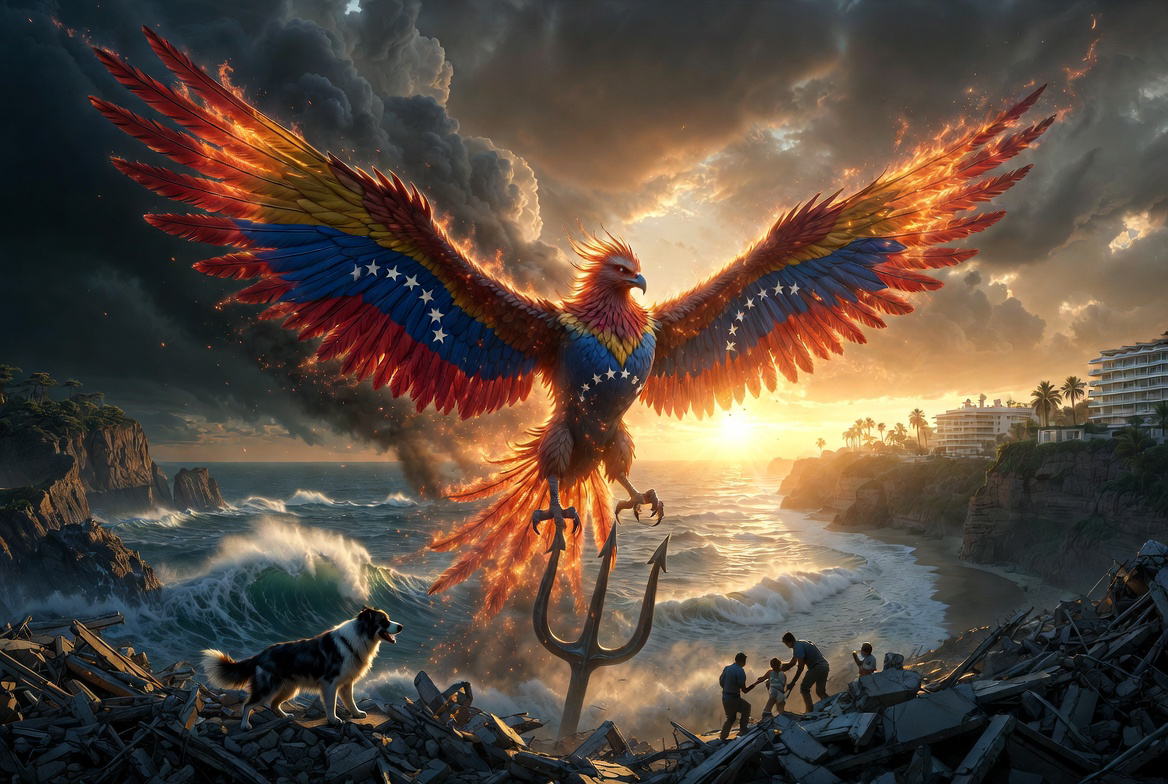
Among the heroes of this story is one who did not choose rescue as a vocation but as redemption: a border collie who suffered abuse and abandonment in his youth before being rescued by a protective association, trained as a certified search dog, and had already worked in Turkey and Syria in 2023, and in the Las Tejerías mudslides.

In La Guaira, guided by his handler, he located a sixty-year-old man trapped in a building in San Bernardino and took part in locating hundreds more. He barked insistently, went rigid to signal a find, and led the teams to the miracle.
Today, after this mission, he retires. His story, from victim to savior, is the best metaphor for what Venezuela can do with itself.
He recalls, more than two decades later, the rottweiler who became a symbol of the Vargas tragedy of 1999: the animal memory of this country, it turns out, is more loyal than the memory of its institutions.
Alongside him worked more than three thousand rescuers from nearly thirty countries: brigades from the United States, El Salvador, Chile, Mexico, Colombia, the Dominican Republic, Spain, Jordan, Portugal, Ecuador, Argentina, Brazil, Switzerland, Qatar, and so many others who turned solidarity into the only effective foreign policy Venezuela has had in recent years.
El Salvador’s president did not limit himself to words of encouragement. He dispatched more than three hundred rescuers, fifty tons of humanitarian aid across multiple flights, and personally took on the medical bills of those affected.

Qatar set up an air bridge. South Korea committed millions in aid. Argentina sent canine search units. And so many more.
Each of these gestures: medical tents, collection centers, water treatment plants, surgeons operating in the open air, refutes the worst temptation of our times: to believe that generosity has vanished from the world.
It has not vanished; it was only waiting, as it always waits, for a tragedy to summon it. That efficiency and that concrete empathy contrast brutally with the paralysis and improvisation that characterized, for decades, the official response inside Venezuela.
None of this happens in a vacuum. On January 3rd, 2026, in a lightning military operation, the United States captured Nicolás Maduro and transferred him to New York to face narcoterrorism charges, beginning to close out twenty-seven years of a power that believed itself perpetual.
It was, for many Venezuelans, the first good earthquake: one that buried not lives but a status quo that had spent too long burying hope. Relations with Washington began, amid stumbles, to normalize; sanctions on the energy sector began to ease; the American embassy reopened in March after seven years of diplomatic silence.
And amid that reconfiguration, in March, something happened that no one had foreseen: Venezuela’s baseball team defeated the United States in the final of the World Baseball Classic and was crowned champion for the first time in its history. Thirty thousand Venezuelans roared in Miami as if something more than a game were being played in that stadium. And indeed something more was being played: a collective catharsis for a nation battered by political upheaval, emigration, and isolation.

If January 3rd was the omen that Venezuela could free itself from a prison, March was the proof that it could also win. Both episodes precede the June earthquakes, and that is why they matter: a people that had already begun to stand up straight is not a people that disaster can fully return to the ground.
Rebuilding the central coast cannot mean building again atop the same recklessness. History offers examples of how a seismic tragedy can be transformed into an opportunity for reinvention.
Lisbon, razed by the earthquake of 1755, was rebuilt by the Marquis of Pombal with the famous «gaiola pombalina,» a flexible timber cage built into the buildings that absorbed seismic movement: the city that fascinates millions of tourists today was born, quite literally, from its own ruins and from a courageous engineering decision.

San Francisco, devastated in 1906, rebuilt its building code and is today one of the most coveted destinations on the planet.
Kobe, in Japan, turned the trauma of 1995 into the engine of one of the most advanced antiseismic codes in the world.
Concepción, in Chile, rose again from the 2010 earthquake with standards now studied as a regional model.
La Guaira has, in its tragedy, the same raw material as those cities: beach, mountain, colonial history, proximity to the capital. What it needs is not just new brick, but real earthquake-resistant architecture, building codes that are enforceable and enforced, not merely written down, as happened after 1955, and urban planning that understands tourism and structural safety are not enemies but mutual conditions.

Turning Vargas into a tourism powerhouse is not an optimistic fantasy: it is exactly what other cities that were once dust have already done.
No serious geologist can call what happened in June a surprise: what is surprising is that, after five centuries of seismic warnings, the country still builds as if the earth had no memory. It does have one, and it exercises it with a geological patience that does not forgive human recklessness.
That is, perhaps, the most uncomfortable point of this moment, but also the most urgent. The United States, which has already assumed a decisive role in Venezuela’s political transition since January, now has before it the opportunity to accelerate, together with multilateral organizations, the overhaul of institutions hollowed out of technical capacity for nearly three decades: fire departments, civil protection, building codes, applied seismology. And in parallel, to overhaul the rest of the republican institutions without which neither freedom nor democracy can exist.
This is not a matter of symbolic intervention, but of operational stewardship that turns reconstruction into the State’s first policy, above any other agenda.
And here it is worth being explicit: electoral ambition must wait. Venezuela faces, simultaneously, a political transition and a humanitarian catastrophe, and the temptation to turn every reconstruction decision into campaign currency would be a betrayal of the dead.
Before discussing who will govern tomorrow, it must be decided who builds today, with what materials, under what standards, and under what oversight. A country is not rebuilt from partisan calculation; it is rebuilt from the minimal consensus that life, first, must be protected from the next tremor.
There is one way to read this tragedy that reduces it to loss, and there is another that understands it as a purge. Not to minimize the pain, which is real, irreparable, and deserves unconditional tears, but to recognize that destruction sometimes clears away what inertia would never have moved on its own: renewed international interest in investing in the country, oil licenses beginning to flow again, a diplomacy reopening after seven years of silence, an interim leadership forced to show results under the gaze of the entire world.
None of this compensates those who today mourn their own. But all of it can, if handled with honesty, turn rubble into foundation.
The Phoenix does not choose the fire: it endures it. But afterward, it chooses whether to remain in ashes or take flight. Venezuela already proved in January that it could free itself, and in March that it could win.

What remains is to prove, now, that it can also rebuild itself: not as the country it was before the tremor, but as a wiser one, with firmer institutions and a seismic, and political, memory that finally refuses to repeat itself. To those who mourn today, this country owes them that: that their pain not have been in vain.
The phrase «to be born again» is neither accidental nor mere consolation. It is, at bottom, humanity’s oldest gesture in the face of catastrophe: turning destruction into threshold.
The Greeks knew this when they told the myth of Deucalion and Pyrrha, the only survivors of a flood that swept away the world, whom the gods ordered to cast stones over their shoulders so that a new humanity might be born from them. Each person pulled from the rubble of La Guaira is, in a sense, one of those stones becoming a person again.

In Norse tradition, after Ragnarök the world does not disappear: a new one appears. Even Persephone must descend into the underworld before spring can return.

Every great civilization understood the same truth. There is no rebirth without prior destruction. Perhaps the earth speaks too. Perhaps, when it breaks its own crust, it forces societies to break the inertias that kept them motionless. Not because suffering is good. It never will be. But because the human response can turn it into something extraordinary.

And the Phoenix, which does not rise despite the fire but because of it, is the exact image of what this moment asks of Venezuela: that the ashes not be the end of the story, but its fuel.
Venezuela has known wars, mudslides, epidemics, dictatorships, economic crises, and earthquakes. It has always risen again. Because there is something no disaster has managed to destroy: the character of its people.
That almost miraculous capacity to share a plate of food when there is barely enough for one. To open the door to a stranger. To dig with bare hands for hours to save someone whose name we do not even know.
As long as that Venezuela exists, there will be a future. Because cities can be rebuilt. Bridges can be raised again. Roads can be remade. Institutions can be reformed. The economy can recover. And even the collective soul of a nation can heal.
Perhaps, many years from now, when someone remembers these earthquakes, they will not think only of the destruction. They will also think of the moment Venezuela decided to leave behind decades of abandonment and become, at last, the country it always had the potential to be.
So may it be. May the dead rest in peace. May the survivors find comfort. And may from these cracks, opened by the earth, a Venezuela be born at last: stronger, more just, wiser, and more luminous.
Like Don Quixote, who falls and rises again, transforming reality to fulfill his dreams. Like hope itself. Like a nation that, after touching bottom, discovered it was still capable of rising once more toward the light.


Deja un comentario